
Practice
Zen Lessons 2026 1 21

Community Zen today at 6pm, 70 West Oakland Ave #103, Doylestown
In the opening chapter of the 17th century Chinese novel Story of the Stone, known also as Dream of the Red Chamber, a quick succession of disenchantments descend on the half dozen characters. They all look for an exit. Shirchun gives money to an ambitious young guy, who leaves without saying goodbye to find his fortune in the capital. Shirchun later happens to see an eccentric Daoist drawing a lot of attention to himself as he strolls down the path. The melody he is singing is lilting, but the lyrics bitter, as all deeds go to waste and all favors are taken unpaid.
Shirchun suddenly gets the gist, and offers to chant a complimentary commentary to the Daoist’s observations. The offer is accepted. Shirchun’s chant goes on quite a while but there is this telling line:
In vain we roam, but in the end must call a strange land home
And Shirchun abandons his family and village and heads off with the Daoist.
(-)
When Buddhism came to China, having drifted along the Silk Road with so many other ideas, goods, and people, Daoism was long established in both everyday and elite circles. Ancestor worship was central to most people’s lives, Daoism propitiated the spirit and natural worlds, and Confucianism invested the political body with social order, patronage, and state ritual. That’s a simple outline, but it’s enough.
I became interested in Chinese art and poetry a couple years after I finished college. I was working in a clinic in a children’s hospital in Boston, playing music, and loosely acting as house mother for inmates of the house I rented. A few years before, the famous Bolligen edition of the I Ching caught my eye at Brookline Booksmith. The cool grey paper dustcover, the mysterious characters, and the radiant yellow of the cover itself was more than I could resist. But I didn’t quite figure out how to use it.
Around the time that I began taking an interest in the East Asian collection at the Museum of Fine Arts. I also found a large and useful volume of Chinese poetry (Sunflower Spendor) that spanned millenia. I realized that a lot of modernist art and poetry was shaped by Chinese and Japanese aesthetics. And the paintings and ink drawings were entirely fresh to me… the open spaces, the looming, craggy mountains, the sedate bodhisattvas under cool, glowing moons.
The China reflected in these works struck me at a particular moment in my 24 year old life. I would impose periods of austerity on myself, often because I was under a lot of pressure and beginning to crack a little. I would also hole myself up in the library or my bedroom to look at old art books or read barely scrutable poetry.
I had a strange experience with the I Ching. I consulted it about a problem I was having. I didn’t prefer the response, so I cast the oracle again and got this:
YOUTHFUL FOLLY has success.
It is not I who seek the young fool;
The young fool seeks me.
At the first oracle I inform him.
If he asks two or three times, it is importunity.
If he importunes, I give him no information.
Perseverance furthers.
This really spooked me and I didn’t touch the book for nearly a year. But by then I was becoming very interested in Daoism. It was around this time, too, that I connected the term wu-wei. “non-action”, with a teacher of mine from high school, Mr. Driscoll, whose nickname was “Wu Wei Dave”. He taught history and philosophy. He was my first exposure, which I had until then forgotten. But it lay there, waiting.
In truth, I got into Zen because formal training in Daoism was unavailable outside of studying acupuncture or traditional Chinese Medicine. My doctor was a traditional Chinese medicine practitioner. But Zen was the closest thing I could find. And, for better or for worse, it was martial arts Zen that opened that door.
(-)
As appealing as spare, lively, beautiful Zen was, its martial arts expression was very difficult for me. I would like to examine this subject more in these pages someday. There are many secrets that I wish I could make better sense of, to talk to others about, that they would help me make legible. Unfortunately, these secrets are not esoteric mysteries but merely human frailties that are private. So it is, they are the shythysm* that I promised not to tell or *snnng.
(-)
So, in a way, my earliest Zen experiences were oracles, paintings, poems, and long treks in the mountains. And without knowing it, I kept looking for and creating small communities. Those stretches of isolation had a counterpoint in the communities that formed around the houses I rented, the bands we formed, and later, the high school I founded. And of course, our family: my sons, our dog, our friends, the river, the village, the fields, the caves, and the cliffs.
(-)
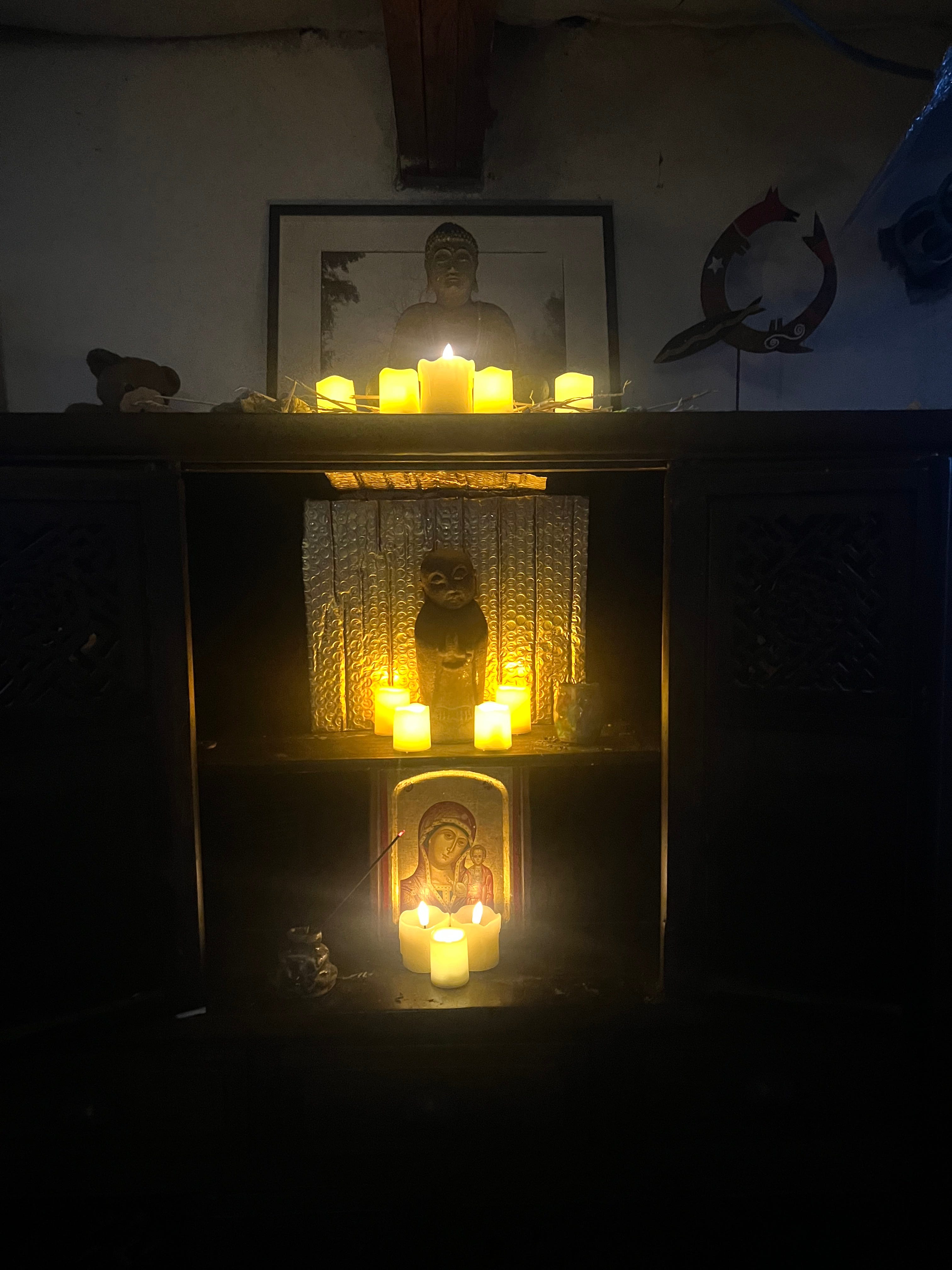
Above is the altar below our house. It has taken years, but the basement is now a working space with bookshelves, pianos, some workbenches and worktables, heat, and a door that opens out to the pool. The altar suddenly became a capstone of sorts… I had been somewhat alienated from the vigor of daily Zen practice I had kept with for many years. The school had closed, covid hit, we sold the house in the country, I built a new business. My dog Milton and I joined a family, with much love, a son, another dog, fields, and river. Overtime, I found my next teacher, my Buddhist guide, as well as other Buddhists, and at last, Buddhist community.
All this inheres when I bow and sit before the altar.
That altar feels to me like I am finally home.
It is this home that is a mystery, not a secret. Family and home have a deep rhythm. Very slow, very funky. You can’t make it up, you have to just do it. Maybe that’s the Zen training, you know, “do it”. It’s got shythysm.
I didn’t feel at home for much of my early life… I wanted to leave. I often left, went to others, seeking something somewhere else. My mother told this story, perhaps not seeing the truth of it, of me age 3 getting up before dawn, before my parents woke up, and leaving the house to hang out with Mr. Beecher, our neighbor, as he got himself ready for work.
In Zen, there is this old term translated as home leaver. In old China home leavers, that is, Buddhists, were thought to have abandoned their families and quit the ancestor rites and joined a foreign religion that cut a person off from caring for the old and caring for the young.
So Zen people in China, Chan people, created lineages of ancestors and descendents so they might have some credibility in that old Chinese way. Chang Sik Kim, the Zen master I trained under for years, had as his teaching name Sa Bu Nim, “Honored Teacher Father”.
Early on, I felt the home-leaver pull. It was intense. But more intense, and what I needed more, was home. I kept making home, here and there, until I was here.
And back to the beginning of this post:
In vain we roam, but in the end must call a strange land home
Or maybe, if we are awake, home is always a strange land.
(-)
*Shythysm is a made up word (by me) that refers to the rhythm of story or song that conveys the most meaningful aspects of it. That is, without it, or with a different shythysm, even if the words and melody are identical, the meaning is entirely changed.
*Snng is the “just shy of fully expressing” the shythysm, before the breath fills the vowel that makes it speakable or singable. This is also a made up word.