
Backwards through Mark: Testing Students
Zen Lessons 2025 4 4: ch. 7-9 pt 2

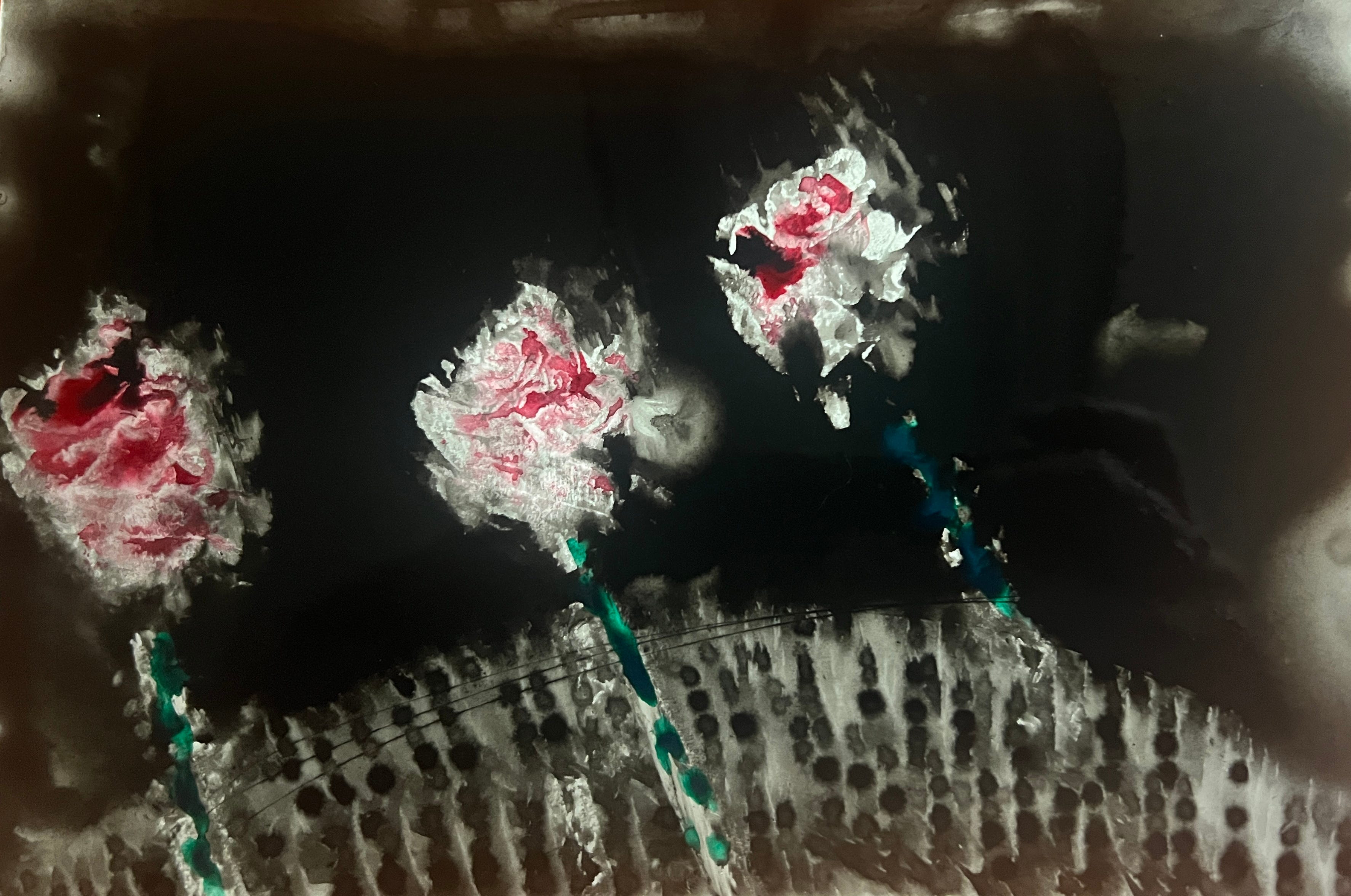
Space-in, Carnarations, ink on yupo paper, 2025
Although Jesus comes from nowhere and doesn't really eat or sleep (until nearly the very end, and subsequently rejects all eating and sleeping) he makes his students sense what he is going to go through, he invites them to experience the the coming isolation and torture. They sidestep it all... and even with continued warning they stumble along in thier ambivalent way.

Pt 2

7.

Later, he began to teach them
that the earthly son
must suffer much
and be rejected by the elders
by the high priests and scholars,
and be killed just after,
and rise three days later...

And Peter implored "no, not that!"
and Jesus turned upon him
and said:

Get thee behind me, Satan.

You are thinking not
of the things of God
but of things of man.

If some of you would follow me
and deny yourself and take up your cross,
you will save your life.

If some of you
seek to save your own life
you will certainly lose it.

Whoever of you
should lose your life for me,
both for me and the good news,
will save it.

How can it help a person
to gain the whole world
and forfeit their soul?

What can a person give
in exchange for the soul?

Whoever of you
is ashamed of me and my words,
in this adulterous and wrongful generation,

The earthly son
will be ashamed of you
when he arrives in the glory of your father
and with the holy angels.

Amen, I say to you.

There are some of you standing here
who will not taste death
until you see that the kingdom of God
has come with power.

8.

There is an apocalyptic strain, too, in Zen Buddhism, with many pronouncements over the centuries of "living in an age of demons" and other such things that point to a fallen state. But Zen teachers usually reject mysticism and the transcendental, instead pointing the student or reader to their own direct, immediate experience. Jesus is himself, in Mark, a very abstract creature who floats without bodily needs towards his destruction. There are here echoes of Hebrew tradition in Abraham trying to murder his son, Isaac, or when God nearly kills Moses. And here, Jesus has a Moses moment himself.


He took Peter, Jacob, and John
to a high mountin
he was transfigured before them,
so white that it blinded them.

"Let us make three shelters,
for you, for Moses, for Elijah."

They were terrified.
A cloud cast a shadow.
A voice came and said:

This is my beloved son, hear him.
Suddenly, there was no one there but Jesus.

9.

When Jesus heals the sick, do they actually benefit? Why does he do this? Is he helping them or merely using them to further his aims of provoking the Jewish and Roman authorities into the violence he is courting? Are these children and outsiders props to get his followers to see the truth he claiming to embody? If there is one thing above all others that drew me to Zen it is the unwavering rejection of magic.

The rejection of magic sits us firmly in the realm of what is direct and real. In Zen, living beings are not a means to an end. In the teachings of Jesus, they sure seem to be.


As they walked done the mountain
he ordered them to tell no one
that the earthly son has risen from the dead.

A scholar asked:
"Musn't Elijah come first, what does this mean?"

Elijah will come and restore everything
Isiah has written the he must come and suffer much.
They did with him what they pleased.

"I believe! Help my unbelief!"
the father cried as he approached Jesus.
No one else could cure his son
of a speechless spirit.

Foaming with convulsions,
then stiff as the dead,
all this as scholars around them argued
about what Jesus can or may not do.

Jesus stated:
All things are possible for the one believing,
and after screams and further convulsions
the boy went seemingly dead.

Yet Jesus held out a hand and the boy rose.

His students asked:
"Why were we unable to cast out that demon?"

I tell you... this sort of demon will only come out
through prayer.

10.

Jesus attempts to push his anti-hierarchal message into every aspect of his students' lives. He makes statements that disconcert the dullards he is surrounded by, who have begun to shape their lives and identity around him. This he rejects. A sidenote: authoritarian "christians" deliberately distort Jesus' use of slavery. Where those grifters assert dominance over others here on Earth, Jesus utterly rejects all hierarchy, save that of God.

They left, Jesus and his students, and journeyed
through the Galilee in secret.
He tried to teach, they would not hear.

The earthly son will be handed over into human hands
and they will kill him
and three days after he will arise.

But they did not understand and the were afraid to ask anymore of him.

They kept on traveling. When they finally arrived
at Capernaum, Jesus asked.
"What were you arguing about on the road?"
They did not answer, for they argued about who was greatest among them.

Jesus sat down and called them over.
Who wishes to be first, will be last. A slave to all.
He motioned to a child nearby and brought him closer.
Whoever welcomes in my name a child like this
welcomes me. And whoever welcomes me
welcomes the one who sent me.

11.

So much of Mark is eliptical and partial. It hints at very human things, such as conflicts between students about status and the "in-group" around Jesus seeking to create cohesion by focusing on outside enemies. Interestingly, Jesus rejects all of this, which hints (again, the hinting) at his universalism, that what he is saying applies to all mankind. But especially to strangers and outcasts. What use is a person without faith? They are salt that has lost its taste of salt. They are nothing to themselves, they are flavorless dust.

Later, John came in saying
"Teacher, a man was casting out demons in your name.
We stopped him."
Do not do such a thing. No one can perform a power in my name
and speak poorly of me.
Whoever is not against us, is for us.
Merely offering you a cup of water in my name,
I tell you, he will not lose his reward.

But for the children
Whoever makes one of these little ones stumble
it would be better to hand a millstone around his neck
and cast him into the sea.

If your hand makes you stumble,
cut it off,
better maimed than enter the unquenchable fire.
If your eye makes you stumble
tear it out, better to be with one eye
than flung into the fire.

Look. Everyone will be salted with fire.
Salt is good, but what good is it
if it loses the taste of salt?

Keep the salt in yourselves
and be at peace with one another."